Showing posts with label new Google doodle. Show all posts

30 November, 2012

Happy birthday, Mark Twain, Mark Twain gets birthday tribute from Google, Pictorial homage to Tom Sawyer graces search engine on the author's 176th birthday

Happy birthday, Mark Twain

Mark Twain gets birthday tribute from Google
Pictorial homage to Tom Sawyer graces search engine on the author's 176th birthday

Wednesday 30 November marks the 176th birthday of the great American author. What's your favourite Twainism?

Open thread
guardian.co.uk, Wednesday 30 November 2012 17.23 GMT

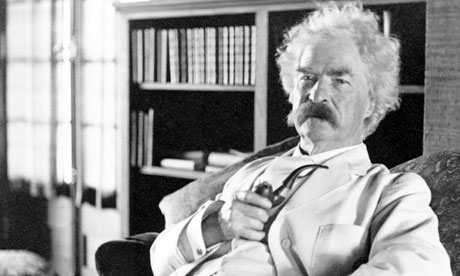
Mark Twain, born Samuel Langhorne Clemens, on 30 November 1835 – 176 years ago today. Photograph: Classic Image/AlamyMark Twain.
As Google has noted with one of its doodles, 30 November marks the 176th birthday of the great American author, satirist and wit. He was celebrated in his lifetime for novels such as The Adventures of Tom Sawyer and The Adventures of Huckleberry Finn, but if Twain himself is right that the definition of a "classic" is "a book which people praise and don't read", then it might be said that his epigrams are his most popular surviving work.
Mark Twain Google Doodle
What is your favourite Twain aphorism?


Mark Twain's birthday doodle from Google.
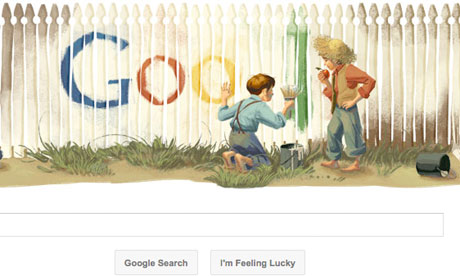
Mark Twain's classic scene of boyhood one-upmanship, when Tom Sawyer tricks his friends into whitewashing a fence for him, has been immortalised online by Google's home page.

The search engine marked the 176th birthday of the American author with a Google doodle today, showing his character Tom Sawyer tempting a friend into whitewashing over the Google logo that unknown and anachronistic hands have daubed over it. In the novel The Adventures of Tom Sawyer, Tom is ordered to undertake the job by his Aunt Polly as a punishment. A "deep melancholy" settles upon him as he surveys the fence, "thirty yards of board fence nine feet high".

When boys begin to approach and ridicule him, Tom persuades them the work is fun. "All I know, is, it suits Tom Sawyer", he tells them. "I reckon there ain't one boy in a thousand, maybe two thousand, that can do it the way it's got to be done." They take the bait and bribe him with their treasures to let them whitewash the fence for him, as "the retired artist sat on a barrel in the shade close by … literally rolling in wealth".

Twain, born Samuel Clemens in 1835, published The Adventures of Tom Sawyer in 1876 and its sequel The Adventures of Huckleberry Finn in 1884. Ernest Hemingway said in the 1930s that "all modern American literature comes from one book by Mark Twain called Huckleberry Finn", and the novels are still hugely popular today, with Huck Finn hitting the headlines earlier this year over an Alabama-based publisher's much-criticised decision to publish a new edition replacing the offensive term "nigger" with the word "slave".

Twain died in 1910 and remains one of America's best-loved authors. His autobiography was finally released last year: Twain had specified that it remain unpublished until a century after his death, so that he might feel free to speak his "whole frank mind" as he would be "dead, and unaware, and indifferent".

Google is clearly in a literary mood at present, with the Twain doodle following a celebration of Polish science fiction author Stanislaw Lem last week. Other authors to have been honoured by the search giant include Antoine de Saint-Exupéry, Agatha Christie, HG Wells and Jorge Luis Borges.


Earn From Your blog And Popular FB page...
ADfocus

22 May, 2012

Google’s Moog Doodle: The Inside Story

Google’s Moog Doodle: The Inside Story
23/05/2012 by Lance Ulanoff on Mashable

Why do Google Doodlers build the things they do? They’re fans, that’s why. When Google’s Chief Doodler Ryan Germick and Google Engineer Joey Hurst decided they wanted to build the Google Moog Synthesizer Doodle, it was to “Pay tribute to someone who was like a patron saint of the nerdy arts,” said Germick.

Germick told Mashable that he was a huge Robert Moog fan. Moog, who died in 2005 and would have been 78 today, developed what is widely recognized as the first commercial synthesizer. Previous versions were the size of closets. Germick called him “a passionate toolmaker.”

Hurst and Germick collaborated on last year’s playable Les Paul guitar Google Doodle, but it was Germick who brought this project to Hurst — who actually celebrated his birthday one day before Moog’s — as a kind of a challenge. “Joey is an amazing engineer and I love to come up with a way to stump him,” explained Germick.

The concept was to recreate the Mini Moog Analog Synthesizer in a Web browser. Germick thought there was no way it could be done. Hurst, who knew someone who owned an original Moog, was instantly excited by the project.

Hurst obviously succeeded, but it wasn’t easy. The project, which was done on Hurst’s 20% “work on what you want at Google” time (he is not on the Google Doodle team), took almost four months from the first mention to the roll-out. That unveiling actually began yesterday in parts of the world where it was already the 23rd. Hurst explained it was probably one of the most involved engineering efforts they’ve ever had for a Google Doodle and required thousands of lines of code.

Hurst said he was excited to show the first functioning version to Germick. “It looked terrible,” said Germick with a laugh, but it was producing audio. “That’s the joy of programming in general. You spend a little bit of time and you can make these really amazing things,” said Hurst.


Interestingly, there was a recent development that helped make the fully-functioning, virtual Moog device possible: a new API from Google. Hurst said Google recently added the Web Audio API to Google Chrome. It provides, he said, “Really high-quality, low-latency audio” in the browser, but not in all Web browsers. Outside of Chrome, the Moog Doodle turns into pure Flash.
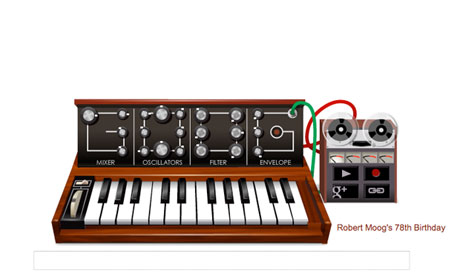
If you haven’t checked out the Google Doodle yet, then you may not understand how complex it really is. The Google Moog has 19 full-functioning knobs, one wheel, a switch and four tracks that let you record up to 30 seconds of overlaid audio. As with the Les Paul Guitar doodle, you can play, record and share, via a link or Google Plus.

Of course, all that complexity can be overwhelming. I fiddled around with the Moog Doodle, but had no idea what any of the knobs did. Fortunately, both Google and Moog Music are providing a key that offers a larger image of the Moog Doodle and guides on what everything does.

“We had a terrific blueprint,” said Germick. “The synthesizers that Moog made were really works of art in and of themselves.”

Google also got full cooperation from both the Bob Moog Foundation, which is run by Moog’s daughter, and Moog Music. “They could not have been sweeter, nicer, better partners,” said Germick.

What the Moog Doodle does not have, though, are any Easter Eggs — or at least any that Germick and Hurst would tell us about. The fun, they said is in fiddling with all the knobs to create “weird sounds.” In fact, Germick even recreated some from his youth, including the Pac Man sound effects.

You can learn more about how to play the Moog Doodle here and at the Google Doodle blog post.

Share your musical creations and Moog Synthesizer secrets in the comments. The photo below shows the Moog Doodle’s creators, Germick (left) and Hurst.


Source: Mashable
Subscribe Blog Admin On Facebook
fb.me/grafix.designer

Robert Moog's 78th birthday celebrated in Google doodle, Music pioneer Robert Moog, who would have been 78 on Wednesday, has been celebrated with a Google Doodle

Robert Moog's 78th birthday celebrated in Google doodle
Music pioneer Robert Moog, who would have been 78 on Wednesday, has been celebrated with a Google Doodle

Bob Moog Google Doodle Plays The Synthesizer
Be careful. You could spend all your time over there.


Guardian staff
guardian.co.uk, Wednesday 23 May 2012 01.47 BST
Robert Moog Google Doodle

Robert Moog's Google Doodle
Google has marked the birthday of music pioneer Robert Moog by creating a 'Doodle' in the form of an interactive electronic synthesiser which can be played by clicking on its keys using a cursor.

Although musical synthesisers already existed, Moog transformed pop music during the 1960s by producing and marketing a small keyboard synth which could be used with relative ease.

Bands including the Beatles and the Doors used the Moog synthesiser, while others later became fans of the Minimoog, a stripped-down version which followed it in the 1970s.

The New Yorker, who would have turned 78 on Wednesday, had been encouraged to dabble in electronics from an early age by his father and built his first electronic instrument, a theremin, at the age of 14

The pair started their own company in 1954 to sell theremin kits by mail order. After studying at the Bronx High School of Science, Moog attended Queens College before graduating in electrical engineering at Columbia University and earning a doctorate in engineering physics at Cornell.

Of the Moog synthesiser, which appeared in 1964, the inventor was to later recall: "I didn't know what the hell I was doing. I was doing this thing to have a good time, then all of a sudden someone's saying to me, 'I'll take one of those and two of that.' That's how I got into business."

Moog died in 2005 at the age of 71, after being diagnosed with a brain tumour four months previously. However, the Moog sound has lived on, with musicians such as Fat Boy Slim choosing to continue to use it even in the digital era.


WEBpronews

There’s a new Google Doodle honoring Robert “Bob” Moog getting ready to go live tomorrow. However, if you visit the Google Australia homepage, you can enjoy it now, seeing how it’s already tomorrow down under. The same applies with Google Japan. What you’ll find when you navigate there may indeed rival some of Google’s most memorable Doodles, at least in terms of its cool factor and as a time-waster.

For those who may be unaware, Moog invented an analog synthesizer called, surprisingly enough, the Moog Synthesizer. To celebrate Moog’s 78th birthday–you guessed it–Google took a page from the successful Les Paul Doodle and provided us with a playable Moog Synthesizer, which also doubles as the Google Logo, as seen in the lead image. Much like the recordable guitar that was the Les Paul Doodle, the Moog Synthesizer Doodle is capable of recording up to four tracks, which, according to 9to5Google.com, can be shared on Google+.

Aside from the recording feature, there are a number of sound effect options including mixers, oscillators, filters and envelopes. There’s also a dial for pitch on the left side of the Doodle, and all of the effects are usable, giving the creative types tons of options to play with.

It should be noted that some in WebPro office were experiencing difficulty with getting the Moog Synthesizer Doodle to play. When some of my coworkers clicked the keyboard, they were taken to the search results page for Robert Moog instead of getting sound in return. Another coworker discovered that if you open the Les Paul Doodle in a separate window, you can play both Doodles at the same time, meaning we’re just a working drum kit Doodle away from having a workable band that uses Google Doodles as instruments.

As indicated, the Moog Synthesizer Doodle will be live in the United States on May 23rd (tomorrow), but it is already live in Google Australia and Google Japan. Have fun wasting the rest of your day trying to hack out the opening part to Europe’s “The Final Countdown.”

3D car show

Today May 23, 2012 Google is celebrating the 78th Birthday of Robert Arthur “Bob” Moog the pioneer of modern music. The “Bob Moog” Google Doodle were created using HTML 5 and allows visitors to compose and play their own music using the “Bob Moog” Synthesizer (The Google version of it). If you would like to read more about Bob Moog we recommend the “Robert Moog Wikipedia” article and also the Wikipedia article on the “Bob Moog Synthesizer”.

Who was Bob Moog?

The Short Version: Bob Moog was born in the USA on May 23, 1934 in New York. He completed most of his studies in New York at the Queens College, Columbia University, Cornell University, Polytechnic Institute of New York University and Lycoming College in Pennsylvania in the fields of Electrical Engineering and Engineering Physics. Bob Moog was highly educated and part of his education included honorary doctorates from the Polytechnic Institute of New York University and the Berklee College of Music. He spent the early 1990s as a research professor of music at the University of North Carolina at Asheville. Moog was diagnosed with a glioblastoma multiforme brain tumor on April 28, 2005. Nearly four months later, he died at the age of 71 in Asheville, North Carolina on August 21, 2005. The Bob Moog Foundation was created as a memorial, with the aim of continuing his life’s work of developing electronic music.

The Bob Moog “Modular Synthesizer”

Bob Moog invented the Moog Synthesizer. The Moog Synthesizer were a small analog synthesizers designed by Dr. Robert Moog and manufactured by Moog Music. The Minimoog became the most popular monophonic synthesizer of the 1970s, and it was quickly taken up by leading rock and electronic music groups such as yes and Tangerine Dream. – If you are interested in the Moog Synthesizer you should visit the Wikipedia article about the Bob Moog Synthesizer.

Google recommends that you watch the Google Bob Moog Doodle with Google Chrome

On the Google homepage today, just below the Google Bob Moog Doodle there is a small statement saying that you should watch the Bob Moog Doodle with the Google Chrome browser. The Google Chrome browser is made by Google and offers a clean and robust web browser. The Google Chrome browser is one of the best HTML 5.0 supported browsers and brings out the best in HTML 5 designs. The Google Chrome browser extensively supports HTML 5.0 and JavaScript which makes these types of Google Doodles possible.

We have previewed the Google Bob Moog Google Doodle in Internet Explorer 9, Firefox and using the Google Chrome Browser, and we can confirm that the Google Bob Moog doodle is best viewed using the Chrome Browser.

You can download the Google Chrome browser on the Google Chrome page.
13 May, 2012

Google Doodle Offers Sweet Mother’s Day Surprise

Google Doodle Offers Sweet Mother’s Day Surprise
14/05/2012 by Charlie White on Mashable


Google’s done it again, creating a Google Doodle for Mother’s Day that’s touching enough to warm the cockles of even the hardest heart.

There’s mom, the blue g, standing there all alone wearing her string of pearls and wondering if those two little ones, her brood depicted as the letter “o” in red and yellow, will remember to honor her on this special day.

As you can see, she’s not disappointed, as they come running through the door with their tiny floral offering and heaping helpings of love, jumping into her arms and showering her with love and thanks for bringing them into this world.

Makes me want to call my mom. Thanks, Google.

By the way, see this little gem for yourself by going to Google.com, and here’s a little viewing hint: Ironically, the animation looks a whole lot cleaner in the Firefox browser than it does on Google’s own Chrome browser.


Source: Mashable

Google doodle celebrates Mother's Day

Tech | Updated May 13, 2012 at 04:02pm IST
Google doodle celebrates Mother's Day

New Delhi: Though every child wishes her mom Mother's Day, but there is someone who is omnipresent and wishes Mother's Day to all moms of the world. Ubiquitous Google, with its today's heart-touching doodle, wishes all moms "Happy Mother's Day".
It's just an amazing doodle from Google this Mother's Day. As you open the Google homepage in your browser, the second "G" of the term Google will appear that symbolises a mother. Suddenly, a door opens and G's children surprisingly come running, and wish her Mother's Day with a flower, hug her and cling to her tightly. But, who are these children? Interestingly, the two Os in the Google logo turn into kids.
This animated doodle has the complete feel of Mother's Day. The second G (that represents mother) is wearing a necklace, thereby making it look like a female. The doodle features two Os as kids, who are standing hand in hand.
Google doodle celebrates Mother's Day
As far as colour scheme is concerned, all the Google colours - red, yellow, purple, green and blue - are there in today's Mother's Day doodle.
Google has been celebrating Mother's Day with its doodles for a number of years now and the Mother's Day doodle always has a flower in it.
While Mother's Day is celebrated on different days in many parts of the world, it is the second Sunday of May (May 13 in 2012) when it is most widely celebrated.
Anna Marie Jarvis, had started a campaign in 1907 following her mother's death to make Mother's Day a recognised holiday in the US. In 1912 she obtained trademarks for the phrases "second Sunday in May" and "Mother's Day" and established the Mother's Day International Association. US President President Woodrow Wilson signed a law making the holiday official. But Jarvis was disappointed with the commercialisation of the event.
The ancient Greek and Romans also held festivities in honour of their mother goddesses. In Britain and Celtic Europe, goddess Brigid and later St. Brigid were honoured with a Mother's Day in spring.
On March 21, to commemorate the Arab Mother's Day, Google had put up a Mother's Day doodle on its home pages in Arab countries including Egypt, Bahrain, UAE, Jordan, Libya, Kuwait, Lebanon, Oman, Qatar and Saudi Arabia.
Mother's Day 2011 Google Doodle: Last year, the Google doodle had a greeting card feel about it.


Source: IBNlive

08 May, 2012

Type ‘Zerg Rush’ Into Google for a Pleasant Surprise

Type ‘Zerg Rush’ Into Google for a Pleasant Surprise
April 27, 2012 by Todd Wasserman


Google is giving us another reason to goof off on a Friday with an Easter egg related to the popular game StarCraft.

If you type “Zerg Rush” into Google, the “O’s” in Google take over the page. If you double click, your cursor turns into a plus sign. Click on the O’s and you wipe them out. Google then tabulates your score and, in a social media twist, lets you post your score on Google+.

For the uninitiated, Zergs are an alien race of insectoids in Blizzard Entertainment’s StarCraft. In the game you “rush” them by amassing your battle units and blitz them.

Google’s motivation for this latest Easter egg is unclear, except perhaps as a way to migrate more users to Google+.

If you Google the term 'Zerg Rush' you will be in for a big surprise.
As soon as you do, the coloured letters 'O' turn into aliens that devour the page - and you can click on the little 'aliens' to kill them.
The hidden 'Easter Egg' is a reference to the space strategy game Starcraft, where using a 'Zerg Rush' with the game's 'Zergling' creatures is often a winning strategy.

Google has a long tradition of hidden 'Easter Eggs' - as well as its famous Google Doodles.
Even by Google's standards, though, this joke is particularly geeky.
The 'Zerg' are one of the races in a strategy game, Starcraft - and experienced players often rely on the 'Zerg rush' to win games.
The verb 'to Zerg' is now often used in other online games, meaning to overwhelm an enemy through sheer force of numbers.
The game Starcraft was released in 1998, but is still played today.
Maker Blizzard entertainment says, 'In the distant future, the newly formed Terran Dominion faces the arrival of two hostile alien races: the savage Zerg and the enigmatic Protoss. Gather resources and expand your forces to lead them to victory. The only allies are enemies. The only choice is war.'
You have to search from the Google home page to make the 'trick' work, and it may not work in mobile browsers or some desktop browsers.


Thumbnail image courtesy of iStockphotoalija


Source: Mashable

Earn With ADfocus

Howard Carter celebrated in Google doodle

Howard Carter celebrated in Google doodle
Google homepage graphic pays tribute to archaeologist who discovered Tutankhamun's tomb in 1922

Staff
guardian.co.uk, Wednesday 9 May 2012 01.36 BST

Howard Carter celebrated in a Google doodle. Photograph: Screengrab
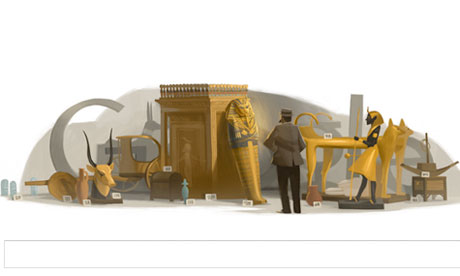
Howard Carter celebrated in a Google DoodleThe birthday of Howard Carter, who discovered the tomb of Tutankhamun in 1922, is celebrated in the latest Google doodle, a colourful graphic depicting the British archaeologist admiring an array of ancient Egyptian treasures.

The unearthing of the tomb, which had been undisturbed for more than 3,000 years, was the first time that the final resting place of a pharaoh and all his treasures had been found by modern-day archaeologists.

Carter, who was born on 9 May 1874 in London, originally trained as an artist and was sent to Egypt at the age of 17 to assist in the excavation and recording of ancient Egyptian tombs. He was appointed as the first chief inspector of the Egyptian Antiquities Service (EAS) in 1899 and supervised a number of excavations at Thebes, now known as Luxor, before he was transferred in 1904 to the Inspectorate of Lower Egypt.

He was employed from 1907 by Lord Carnarvon to supervise his Egyptian excavations but came under pressure to make a major breakthrough after what the aristocrat regarded as a series of disappointing results.

It came in November 1922, when Carter wrote in his pocket diary: "Discovered tomb under tomb of Ramsses VI investigated same & found seals intact."

He is said recorded as having made the breach into the tomb with a chisel his grandmother had given him for his 17th birthday.

Asked by Carnarvon: "Can you see anything?", archaeologist replied with the now-famous words: "Yes, wonderful things."

Carter then became the first human in 33 centuries to enter the tomb, and spent years documenting the thousands of artefacts from the tomb.

A total of 5,398 objects were found, covering every aspect of ancient Egyptian life, from weapons and chariots to musical instruments, clothes, cosmetics and a treasured lock of the royal grandmother's hair.

He died from Lymphoma in 1939 at the age of 64, just seven years after his excavation ended, and before he could fully publish his findings.

Carter's complete records of the excavation were deposited in the Griffith Institute Archive at the University of Oxford, which has been building an online database.


Earn From Your blog And Popular FB page...
ADfocus

23 April, 2012

Gideon Sundback celebrated in a Google doodle, zip's inventor, birthday of the zip's inventor

Gideon Sundback celebrated in a Google doodle
Latest doodle is a giant zipper running down the search engine's homepage marking the birthday of the zip's inventor

Google doodle zipper


Gideon Sundback celebrated with an interactive zipper Google doodle on the search engine's homepage. Photograph: Screengrab
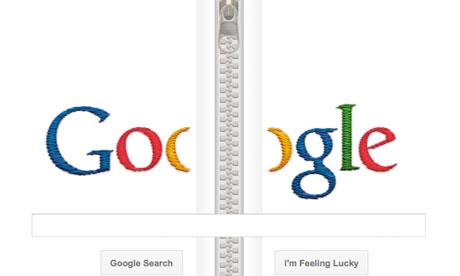
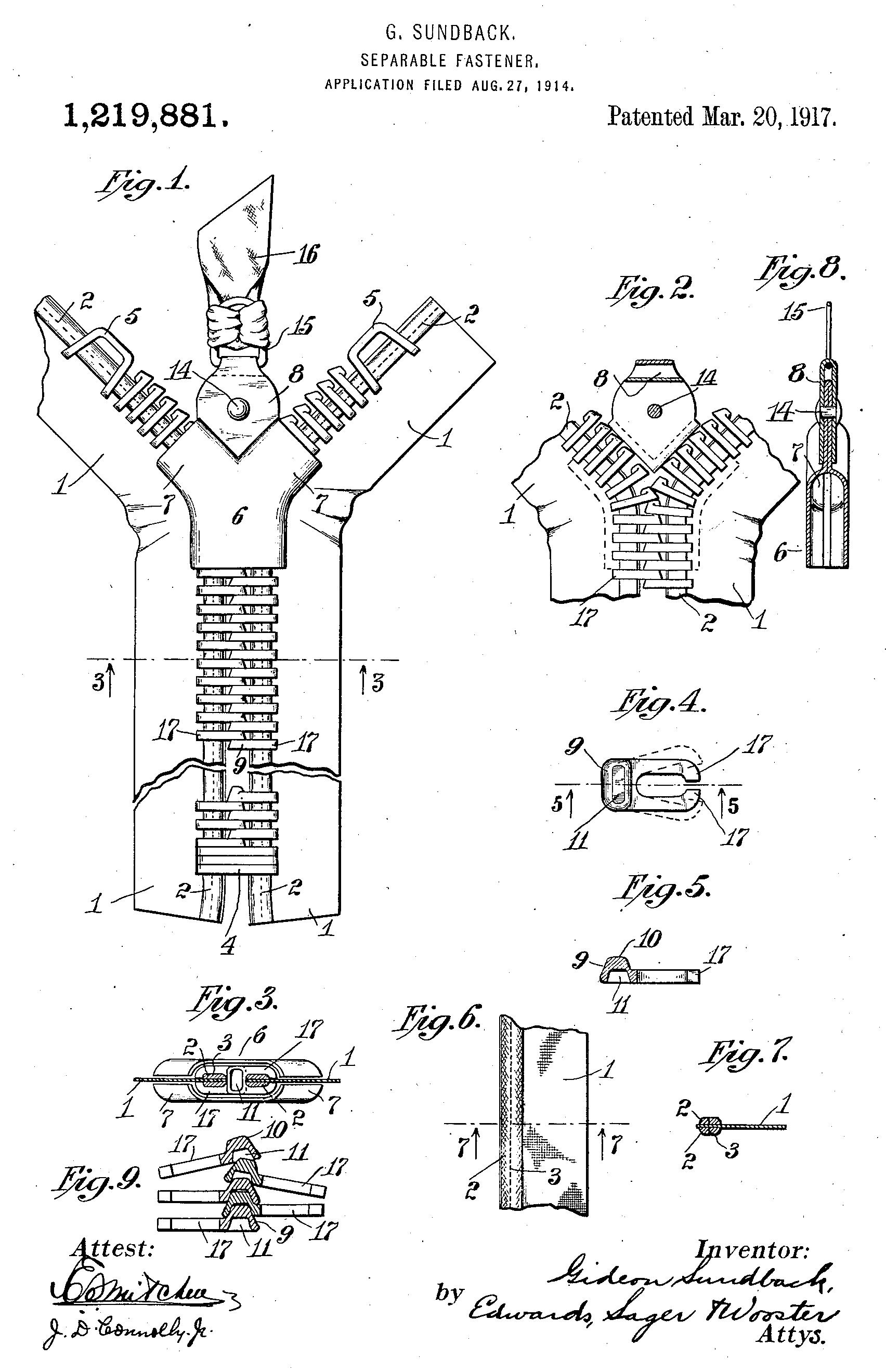
Google's latest doodle, a giant zipper running down the centre of the search engine's homepage, marks the birthday of Gideon Sundback, the Swedish-American electrical engineer most commonly associated with the development of the fastening device that revolutionised the clothing industry.

Before Sundback's intervention, the idea for a fastener based on interlocking teeth had circulated among engineers for more than 20 years but no one had perfected it.

His innovation was to place a dimple on the underside of each tooth and a nib on the top that would sit securely within the dimple of the tooth above it.

As a result, the join between two rows of teeth was then strong because no single tooth has enough room to move up or down and come apart. He also created the manufacturing machine for the new zipper.

Born on April 24, 1880, in Småland, Sweden, he moved to Germany following his studies and emigrated in 1905 to the US, where he started to work at Westinghouse Electric and Manufacturing Company in Pittsburgh, Pennsylvania.

A year later, he was hired to work for the Universal Fastener Company in Hoboken, New Jersey, and became its head designer in 1909.

Sundback initially proposed the new zipper as a replacement for hook-and-eye fasteners on women's boots but it had become a regular feature for the flies of trousers and on dresses by the 1930s.

Sundback died of a heart condition in 1954 and was interred at Greendale cemetery in Meadville, Pennsylvania.

News Source: Guardian.co.uk
Images From : WIKImedia, WIKImedia

21 February, 2012

Heinrich Rudolf Hertz celebrated in a Google doodle

Heinrich Rudolf Hertz celebrated in a Google doodle
German physicist, whose experiments led to the wireless telegraph and the radio, has his 155th birthday marked

Staff and agencies
The Guardian, Wednesday 22 February 2012

Heinrich Rudolf Hertz, the German physicist, has his 155th birthday celebrated in a new Google doodle. Photograph: Screengrab
Google's latest animated doodle celebrates the 155th birthday of Heinrich Hertz, the German physicist whose experiments with electromagnetic waves led to the development of the wireless telegraph and the radio.

Born in Hamburg, where he demonstrated great skill in grasping the dynamics of physics even in boyhood, he later enrolled to study the subject in Berlin following a year at the University of Munich.

In Berlin, his progress in investigating electromagnetic phenomena was so rapid that in February 1880 he received his PhD – on electromagnetic induction in rotating spheres – at the age of 22.

After becoming a professor at Karlsruhe Technische Hochschule in 1885, Hertz turned his attentions to open electrical circuits and demonstrated electromagnetic induction to his students using a condenser discharging through an open loop.

In the course of doing this, he noticed an unanticipated phenomenon, the emergence of 'side-sparks' in another nearby loop. By 1888, he was able to demonstrate that the electromagnetic emissions associated with these sparks behaved like waves.

The finding, which effectively clarified and expanded the electromagnetic theory of light that had been put forth by the British physicist James Clerk Maxwell in 1884, was hailed as confirmation that electromagnetic waves could be transmitted and received.

Hertz's name later became the term used for radio and electrical frequencies, as in hertz (Hz), kilohertz (kHz) and megahertz (MHz).

He died in Bonn in 1894 after contracting Wegener's granulomatosis, a rare disorder in which blood vessels become inflamed, and was buried in Ohlsdorf, Hamburg.

Source: Guardian

Ayeza Khan Photoshoot 2020, Ayeza Khan Photos, Ayeza Khan 2020 New

Ayeza Khan Hot Photoshoot Ayeza Khan Hot Photoshoot, Ayeza Khan, Ayeza Khan Photos