Showing posts with label D800. Show all posts

09 May, 2012

Nikon D800E video samples show stunning resolution in 1080p

Nikon D800E video samples show stunning resolution in 1080p
Monday, 07 May, 2012 20:10

If you are waiting for the out of stock Nikon D800 – it seems your wait might have to go on for a while yet – since the D800E might be the one to get.
The lack of anti-aliasing filter does not seem to make moire and aliasing in video mode any worse. There’s nothing very noticeable here in this video despite all the fine detail like hair, bricks and fabrics. Rather, it has a positive affect and fine detail really pops.
Nikon D800E photoshoot video frame grab
I wasn’t expecting fine detail to be this clean on the E… Removing the anti-aliasing filter seemed like a recipe for disaster. But this footage is very encouraging. When you also bear in mind this is compressed footage from in-camera, rather than via the Atomos Ninja, it truly seems like a very nice result from the rare ‘E’ version.
I recommend clicking the link below to Vimeo and downloading the full 1920x1080p file.
Mosaic Engineering are working on an anti-aliasing filter for the D800, so if you do need to add one later to your ‘E’ that will be available before long (the prototypes are already in the wild).
I’ve been busy the past couple of weeks so haven’t had chance to test my OLPF-less 5D Mark III against a Nikon D800, 5D Mark II or standard Mark III yet but the tests and final conclusion are coming before long. If you are in / near Berlin and have a Nikon D800 or D800E let me know, I’d like to do a shootout with my OLPF-less 5D Mark III and your Nikon! The D800 is out of stock everywhere at the moment and like gold dust.

07 May, 2012

Next generation cinema camera battle – who will win?

Next generation cinema camera battle – who will win?
Tuesday, 24 April, 2012 on EOShd
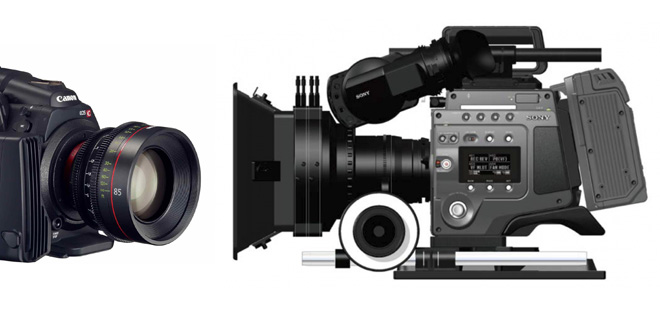
C500 vs Sony F65

In the last few weeks the already large number of options for filmmakers have been shaken up. Current cameras all seem to fall into different niches.

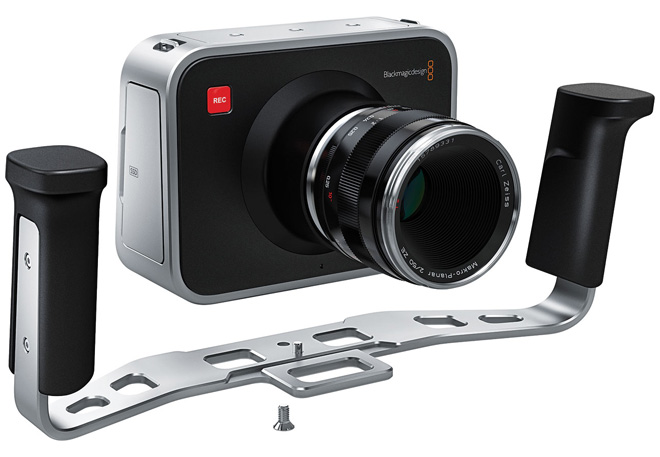
There are the depth of field specialists – 5D Mark III and D800 with full frame sensors. There are the resolution and raw codec specialists the Blackmagic Design Cinema Camera and Red Scarlet. There’s the slow mo specialist the Sony FS700 and my personal favourite all-rounders the GH2 and FS100 which just keep getting better with firmware updates (the FS100 is now a world cam with latest one from Sony).

What happens next will be a fascinating fight. EOSHD rounds up the contenders.

Canon

Should it exist, the C100 is going to have to be cheap. Putting a stripped down C300 out there for $8k isn’t going to work. Putting it between the FS700 and C300 won’t do either, because frankly that isn’t possible – the FS700 is already better specced than the C300 for half the price. It is 4K ready so more future proof, and does 240fps 1080p whilst the C500 will come in at a LOT more – $30,000 in fact. I think the C500 is going to be great for Hollywood and future proof broadcast acquisition in 4K – a viable alternative to the Alexa but there is an awfully big hole under $30,000.

The 4K DSLR is basically a 1D X stills camera and lacks fundamental features like 25p, robust ports like HD-SDI and XLR, or any usability concessions like peaking. A serious mistake in my view and a very very cynical product. It is also said to be disappointing in terms of the image (not true 4K and only a 8bit codec). The 1080p mode is multi-region but said to be no better in image quality than the 5D Mark III or 1D X, which is just crazy! Everyone is in love with full frame and the DSLR form factor for video. Canon should be providing a proper 2K raw DSLR for $6,000 with an electronic ND filter and XLR in a battery grip, scrap the wobbly HDMI port and with a product like this Canon will clean up. There’s simply no excuse not to sacrifice some margin and give us a proper next generation camera, otherwise they risk losing their accidentally won foothold completely.
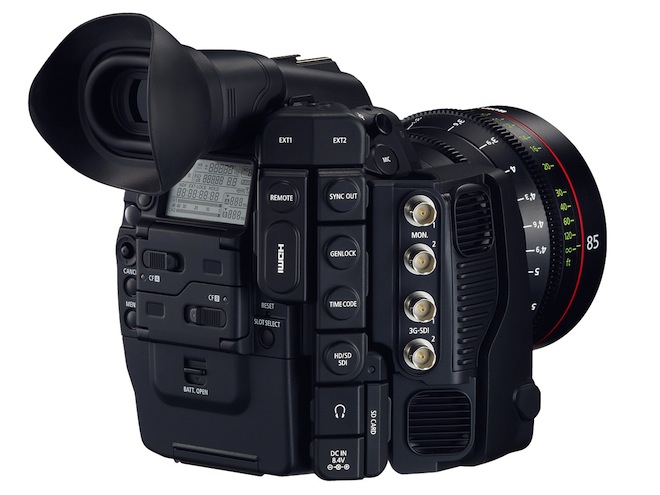
Canon C500

Blackmagic Design
I have to admit that when news of this camera came out I had a vision of the future as clear as day, and I’ll be very surprised if the BMD Camera does not push virtually everyone else to compete, like the iPhone did in the mobile market. Yes there will be a slew of imitators BUT the great strength of a post production company like Blackmagic is their expertise in software and recorder hardware. Their Cinema Camera raw recorder is fully integrated and proven hardware. DaVinci is highly desirable as a professional post production suite. Their in-camera firmware and touch screen interface is also leaps and bounds ahead of Japanese software design.
Blackmagic Design Cinema Camera
Above: 12bit RAW at 2.5K resolution for $3000 – the sensation of NAB 2012
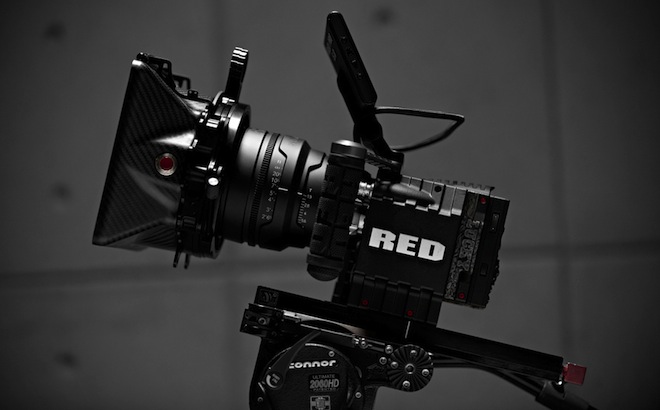
Red
Like Canon, Red seem to be highly focussed on providing for the very high end with industry tools and not so much the lower end. The Scarlet’s ‘brain’ at $10,000 is pretty reasonable. The rest of the kit to get it operational is extremely expensive. I am not paying $3200 for an SSD, I don’t care if it is used by Fincher and Jackson, that price is out of my imagination. Red’s chief competition at the moment is Arri, Sony and Canon. Panasonic have their 4K Vari-Cam coming but until then aren’t in the digital cinema game. Arri have carved up the lions share of both film and TV. Red have a great run with many high profile shoots but their smaller support network causes doubts in the minds of many producers especially in Europe. Sony’s F65 will provide stiff competition at the very top end – though the Epic has the edge on chassis size.
Red like to portray the image of a lone gun-man fighting against the corporate might of Japan. Indeed the big question here is whether Red are corporate enough to fight Arri & Sony in the digital cinema industry or whether they are too much a loose cannon and too small to compete with large multinationals, with their wide support network, trusted brand names, huge engineering resources and strength in depth. Red do well to win high profile shoots like The Hobbit but they need more scope. Lower down, nearly everyone at NAB was in agreement in saying the Blackmagic Design Cinema Camera could be a serious blow to Red’s hopes of securing a mass market footing with 3K for $3k. As for 4K – though we don’t know the price of the 4K recording unit yet, the Sony FS700 certainly seems to undercut the Scarlet – as well as offering higher frame rates (without a crop of the sensor).
Red EPIC
Sony
The FS700 is the bomb. It covers broad range of customers from FS100 upgraders to potential C300 buyers – so right the way from well off consumers to broadcast television, not only as a 1080p camera but as a future proof 4K ready one that does 240fps super slow mo. The 4K add-on later is a touch of genius by Sony because it gives them the luxury of being more flexible with their market approach. The market is changing so fast, Sony can wait until the others have their 4K offerings out and bend to their pricing strategy; They only have to take into account the manufacturing and development cost of the external recorder, since the camera already has a 4K sensor and 3G-HD-SDI for $8k.
Hopefully the external recorder will be small enough to integrate into the camera like the current SSD unit on the FS100 does.
Sony FS700
Panasonic
Panasonic’s GH2 is brilliant and the momentum keeps building (the GH3 is due this year). The hack shows what low end hardware is capable of when truly unleashed. That camera’s sensor and image processor could be in a C300 competitor if it had the same build, built in ND filter wheel, better LCD, better audio and sturdier connectivity. That Panasonic can put a consumer camera like this out with such a knockout image for $600 makes you wonder what they are capable of at $8000 when freed from the kind of unimaginative thinking that plagued the AF100. AVC Ultra seems positive but I have a couple of concerns about Panasonic - the under specced AF100 is a problem as is the lack of a replacement any time soon. Also AVC Ultra is not a raw codec. Canon have EOSRAW, Blackmagic have uncompressed raw, Arri and Red have their own codecs. Where’s Panasonic’s?
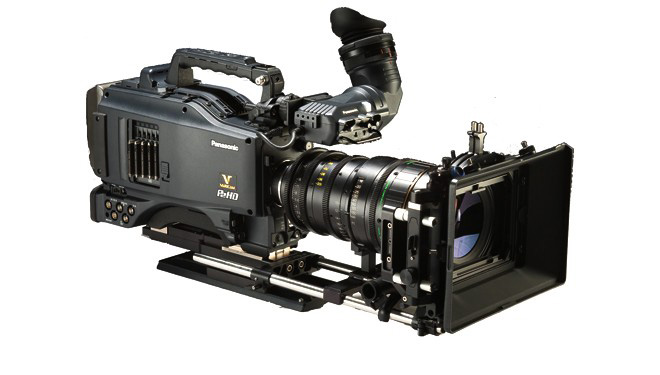
Varicam 3700
Above: the current Varicam is small chip CCD. Where is the Super 35mm version or a higher end offering above the already dated AF100?
And the winner is…
JVC! Only joking.
I originally began this article before NAB and one piece of the original text is quite pertinent now…
“At some point this year there will be a gap that one of these manufacturers will literally walk straight into, whether it is Sony with slow-mo on the FS700, Panasonic with their 12bit codec or Canon with a 4K DSLR.”
Well it turned out to be Blackmagic Design who walked into a gap.
We’re not talking about a small gap either, rather a gaping hole.
I’m astonished how unimaginative the big guys have been in their approach to bringing the mass market to the digital cinema market. The people who will buy the Blackmagic Design Cinema Camera won’t just be a tiny niche of indie filmmakers – they will be stills photographers, camcorder users, DSLR owners, students, artists, freelancers, journalists, small production studios and even some of the bigger ones, broadcasters, wedding videographers and even Philip Bloom.
That is some broad appeal!
Purely by virtue of silly pricing, Canon’s Cinema EOS stuff doesn’t have the same broad mass market appeal and their stills DSLRs aren’t giving us what we want (a major missed opportunity).
Whilst the Blackmagic camera is great remember however that it is only one product. Although the singular Apple iPhone mopped the floor with manufacturers who had 100′s of different models and variations on the market, filmmaking is more diverse than the world of pocketable Nokias. I think by virtue of pushing so hard on specs and being aggressive on pricing Sony are going to come out top dog. The F65 is more powerful than the Alexa for a similar price – $65k. The FS700 offers just so much for $8k it is mind-blowing. The FS100 for low budget shooters is a much better option than a Canon DSLR. Sony are also being pretty brave with their DSLRs as well – first to put 1080/60p in there – first to do a pro mirrorless camera with the NEX 7 and their sensor in the Nikon D800 is probably the best full frame sensor in the world right now. I can’t wait to see what their full frame A99 is capable of in video mode (remember it is in their new business strategy to push 4K tech to consumers).
So I can see Sony cleaning up in a broad range of areas, Blackmagic cleaning up at the $3000 point, Arri maintaining a good footing in worldwide high end production and everyone else picking up the crumbs from under the king’s table.


Source: EOSHD.com

Earn Money.....Short You URLs....


http://adfoc.us/

01 April, 2012

Nikon Unveils D800, the World’s Highest Resolution Full-Frame DSLR Camera

Nikon Unveils D800, the World’s Highest Resolution Full-Frame DSLR Camera

February 07, 2012 By Peter Pachal On Mashable

Nikon keeps looking for more mountains to climb. A little after unveiling its new D4 flagship DSLR and a point-and-shoot with world’s longest zoom, the company has announced a new special-format camera that’s said to be able to capture photos with higher resolution than any commercially available DSLR on Earth.
The camera is called the D800, and it snaps photos at a whopping 36.3 megapixels, more than double the maximum resolution of the D4, which maxes out at 16.2MP. The D800 can capture those ultra-crisp photos thanks to its full-frame CMOS sensor, which Nikon calls FX format. “Full frame” means the image sensor is the same size as a frame of 35mm film — significantly larger than a typical APS-C sensor in a normal DSLR.
When you have that many pixels, you need performance that can handle it, and the D800 boasts a new image processor called the Expeed 3. With the full-frame sensor and processing engine, Nikon says the camera’s pixel count is the world’s highest, though it qualifies the claim by only including DSLRs with interchangeable lenses with full-frame sensors. Medium-format cameras, such as ones made by Hasselblad or Phase One, can have pixel counts much higher.
SEE ALSO: HOW TO: Get the Most Out of Your New Nikon D3100
The D800, though, has all the advantages of a DSLR, able to swap out lenses easily, capture video (at 1080p, 30 frames per second) and an ISO that you can crank up to 6400 (native) or 25600 (equivalent). With the optional MB-D12 battery pack, you can even enable a continuous-shooting mode that snaps six of those full 36MP images per second.
Besides all that good stuff, the D800 has an extra sensor that helps ensure any people you shoot aren’t overexposed, even if they’re backlit. The 91,000-pixel RGB sensor automatically detects human faces in the frame, determines the right level of exposure, and allows for better autofocusing, flash control and white balance.
For pros that want total control of their photos can instead opt for the D800E, which allows disabling of some camera’s filter functions (aliasing and moiré pattern reduction) so light from the lens hits the sensor directly. Nikon says that’s better for landscape and artistic photography.
The D800 will be available in March for $3,000, followed by the D800E in April for $3,300. You can check out some sample images from Nikon taken by both cameras in the gallery below (full resolution pics are on Nikon’s site). Below the gallery you can view a short movie that was shot entirely by a D800.
Are you a photographer? Is the D800 as drool-worthy as Nikon thinks? Give your take in the comments.
Joy Ride from Sandro on Vimeo.

31 March, 2012

Using the Nikon D4: First Impressions

First Impressions: Using the Nikon D4

By Barney Britton | Published Mar 7, 2012 | Product Reviews & Previews


The Nikon D4 is a serious photographic tool at a serious price. At $6000 the D4 is twice the cost of the recently-released D800, and offers just under half of its pixel count. But it's what the D4 does with its pixels - and how quickly and reliably it does it - which makes it so potentially attractive to working professionals. The D4 is built for speed and versatility. It might not offer the highest resolution on the market, but it is designed to deliver its 16MP images at a rate of 11 per second in all winds and weathers.

A few days ago we took delivery of a factory-fresh production D4 in our Seattle offices and it's hardly been turned off since. We've already published a detailed overview of the D4, and we've also asked a group of professional photographers what they think, but in this article, I'll be explaining what the D4 is actually like to use, as we move forward towards a full, in-depth review.

Full disclosure here, I use a D3S regularly, and outside of my day to day shooting for dpreview, much of my personal and professional photography over the past five years has been shot using either the D3 or D3S. Like all camera reviewers I swap between different systems constantly, but I happen to know the D3 and D3S very well.
The New York Dolls, 2009, taken on a Nikon D3S at ISO 8000 (processed Raw) 

Denmark Hill, 2010, taken on a Nikon D3X at ISO 320 (Processed Raw) 
Biffy Clyro, 2010, taken on a Nikon D3S at ISO 6400 (Processed Raw) 
Kentish Town, 2009, taken on a Nikon D3 at ISO 400 (Processed Raw)
That said, bear in mind that this article is not a review. That's in the pipeline. Also, I don't pretend to speak for all photographers, so if you think I've got something wrong, or I haven't mentioned something that you really like (or don't like) in this article feel free to leave a comment. You'll find four pages in this article, the first three comprise a quick overview of my early impressions of the camera, both good and bad, and page four is reserved for samples - studio, real-world and video clips.

Overview


The D4 is a heavy, chunky camera, just like the D3S which it replaces. But whereas the D3S inherited the 2007-vintage D3 chassis, the D4 brings new ergonomics as well as an updated specification. Cosmetically, the D4 is curvier and more streamlined than its predecessors, and slightly lighter, too. The D4's battery is new, and is not compatible with the older type used in the D3 and D3S. The same applies to the D4's battery compartment door, which looks like it might be interchangeable with that from the older models, but is actually a slightly different size.

Although most of its controls are in basically the same places compared to the D3 and D3S the D4 feels subtly different in use thanks in part to the redesigned hand grip and the steeper angle of the main shutter release.

Compared to the D3S, the D4 looks slightly different when viewed from the top. A red movie shooting button is an obvious addition to the right hand side of the top plate but in this view you can also see that the 3-position metering switch has been removed and metering mode added to the cluster of controls on the upper left.
Changes have been made to the D4's rear controls and control layout as well - two new 'sub-selector' joysticks have been added for horizontal and vertical format shooting and a new live view switch (the same as that used on the recently announced D800) has been added below the LCD screen. 

Key Specifications:


16.2 effective megapixel, full-frame sensor (16.6MP total)
10fps shooting with AF and AE, 11fps with focus and exposure locked, 24fps 2.5MP grabs
91,000 pixel sensor for metering, white balance, flash exposure, face detection and active d-lighting
ISO Range 100-12,800 (extendable from 50 – 204,800)
MultiCAM 3500FX Autofocus sensor works in lower light and with smaller apertures
Two sub-selector joystick/buttons for shooting orientation
1080p30 HD video at up to 24Mbps with uncompressed video output
New EN-EL18 battery (21.6Wh capacity, CIPA-rated at 2600 shots)
Twin card slots - one Compact Flash and one XQD

Ayeza Khan Photoshoot 2020, Ayeza Khan Photos, Ayeza Khan 2020 New

Ayeza Khan Hot Photoshoot Ayeza Khan Hot Photoshoot, Ayeza Khan, Ayeza Khan Photos