Showing posts with label single-lens reflex. Show all posts

22 May, 2012

First review of the GH3′s kit lens? Panasonic 12-35mm GX Vario F2.8

First review of the GH3′s kit lens? Panasonic 12-35mm GX Vario F2.8
Monday, 21 May, 2012 01:20
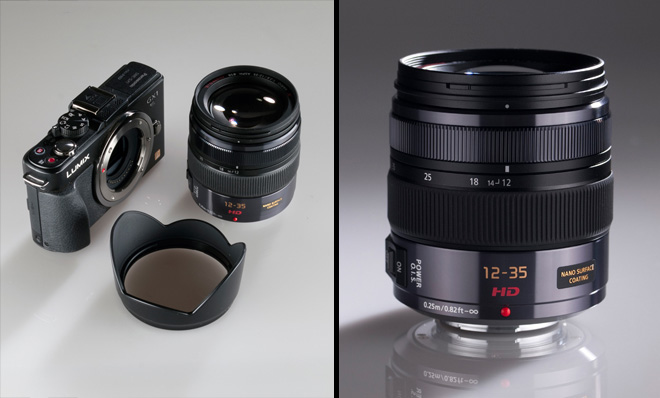
Panasonic 12-35mm F2.8

The weather sealed 12-35mm is Panasonic’s new top of the range Lumix zoom with a constant F2.8 aperture. It’s also the lens most likely to be offered with the (also expected to be weather sealed) GH3. Panasonic have taken a huge step with build quality on this lens and I’m expecting the GH3 to be a big improvement in this area as well.

DSLR Magazine have taken a look at the new lens, and here’s my view on it.

Lumix lenses – the good stuff

One thing that Panasonic’s lenses have got going for them, is their optical quality and level of new technology on display. They have innovated ahead of Canon and Nikon with a list of features as long as your arm – silently operating optical image stabilisation, focus and the iris, AF in video mode, internally focussing elements, a continuously variable iris (again for video) and even a couple of power zooms. Distortion and fringing are corrected in firmware with Lumix lenses, again an innovative approach in integrating the optics and body. Optically a lot of the lenses are tack sharp even wide open especially the 20mm F1.7 pancake and nice but pricey 7-14mm F4 ultra wide (which is optically one of the best wide angle lenses on any system).

DSLR Magazine review summary


You can see the full review at DSLR Magazine here, though it has been translated with Google from the Spanish original!

The 12-35mm GX is Panasonic’s answer to the new Canon 24-70mm F2.8 II. It features a constant F2.8 aperture, video optimised Power OIS, four aspherical elements (yes FOUR!), a 25cm minimum focus distance and Panasonic’s new nano-particle coating. DLSR Magazine were impressed with a almost complete lack of vignetting and distortion, a very high resolution at all focal lengths and the general build quality (weather sealed) of the lens. Sharpness is a particular strong point of this lens, even wide open it exceeds what the sensor can resolve. So their chart has resolution as high at F2.8 as it at F5.6 when stopped down.

My take on the Panasonic 12-35mm F2.8

Is this lens worth 1100 EURO or does it fall short of expectations? Initially rumoured as an F2 zoom, the thing that holds back the Lumix system for me is that the philosophy of Micro Four Thirds is… Micro. That’s largely a good thing – but this philosophy extends to the top end stuff like the GH2, when really it should be kept for the likes of the GX1 and GF range and a few of the lower end lenses. There’s only so much you can do with small equipment! The pancake lenses like the 20mm are pocketable, as is the amazingly small 14-42mm PZ. But lets face it, a fast 12-35mm zoom is never going to be. Although it is laudable that a 24-70mm F2.8 equivalent is less than half the size of the Canon full frame equivalent lens, I’d have preferred to have seen Panasonic stretch the specs and produce a larger optic to compete with the Olympus Four Thirds 14-35mm F2.

12-50mm F2 would have been really attractive.

Instead we’ve got a very good F2.8 wide-zoom with a limited reach at the long end. It costs more more than buying an Olympus 12mm F2 and a Olympus 45mm F1.8… The primes seem more appealing to me, but if you really must have a zoom then the 12-35mm F2.8 is now the very best the Micro Four Thirds range has. For those who want a walk-around lens for photography it is perfect.

For most narrative filmmakers, they’ll be better off with primes. But documentary shooters and run & gunners will find the video optimised OIS and AF appealing as well as the constant aperture which won’t affect exposure during a zoom. The 12mm wide end (24mm equivalent) is far more appealing than just 14mm (28mm). Though I’d have much preferred an aperture of F2, F2.8 is just about suitable for low light shooting and will give a pretty shallow depth of field at the wide end with close focus distances and at the 35mm end in general. It isn’t a match for the look of a Canon 24-70mm F2.8 on the 5D Mark III in terms of shallow depth of field, but it is every bit the premium optic.


Source: EOSHD

09 May, 2012

Lenses and putting the life back in – Why expensive is not always better

Lenses and putting the life back in – Why expensive is not always better
Tuesday, 08 May, 2012 00:53

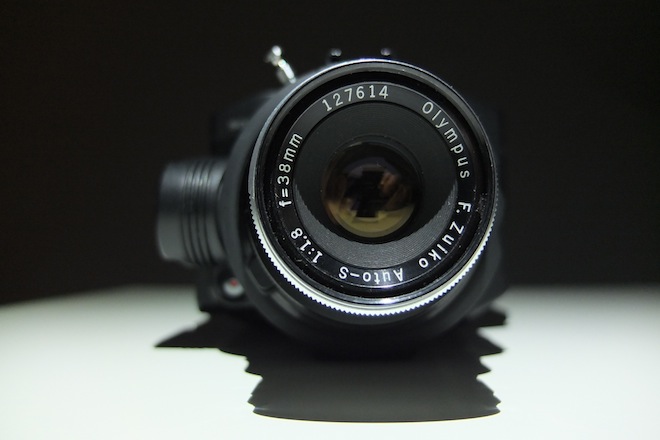
Bokeh distortion with the Olympus PEN-F 38mm F1.8
Putting the life into an image is an art.
It isn’t always about Canon L glass.
Here I’ll explain exactly why this is and how to get the most from the more ‘unusual’ lenses on eBay.
Beautiful but vacant imagery in the vain of a glossy network TV show - this isn’t really my cup of tea.
I’m more interested in adding a very personal mark to my cinematography – what is the point of mimicking Game of Thrones or Lost? It’s already been done, in crisp clean HD where available™
I just shot this single cover for a musician friend – why the hell do I need a sharp lens to do this?
Dreamleaver by Herdwhite
I have never felt compelled to look at MTF chart when buying a lens, rather, I look at the images it produces on Flickr. Here’s an example of something unusual… a vintage cinema lens, the Cooke Kinetal 12.5mm.
It is far from technically perfect. The coating is 1950′s technology. There’s a rainbow all over the right hand side. The bokeh is very textured with halos around it that somehow emphasise the presence of the bokeh, rather than making everything creamy clean and boring.
And you know what? It works.
Cooke Kinetal 12.5mm vintage cinema lens
This lens was crafted by hand in England through the 60′s and 70′s. A computer didn’t come close to it. Ditto the Kern Switar 26mm F1.1 which was made by the hand of a human being not a machine.
Somehow these lenses breathe life into the clinical sterile world of HD (and 4K). My firm advice is to embrace the unusual and split your collection between the technically superb and the creatively unreal.
Whilst it is true that sharpness, lack of flare, zero vignetting and perfectly creamy bokeh is desirable…that kind of lens is but one expression in the language of cinema.
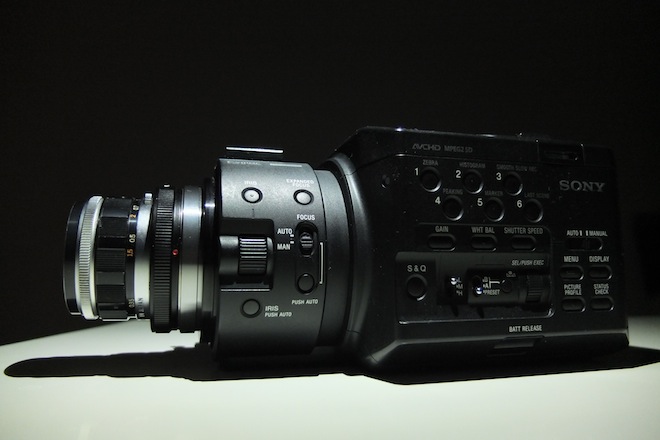
Olympus 38mm F1.8 PEN-F on FS100
Here’s the Olympus 38mm F1.8 from an original PEN-F, made in the 70′s, on the Sony FS100.
This lens mimics the look of full frame rendering on a crop sensor. The lens is designed for a half-frame film camera (the original Olympus PEN), so the edge of the (smaller) image circle is closer to the edge of the frame on crop sensors like Micro Four Thirds, APS-C and Super 35mm. Much closer than it is with your typical full frame Canon L lens.
As a result you get a tunnelling effect to the bokeh, a curving of light at the edges and a gentle vignette in the corners. It’s beautiful.
Click to enlarge:
Olympus PEN-F 38mm 1.8 Sample
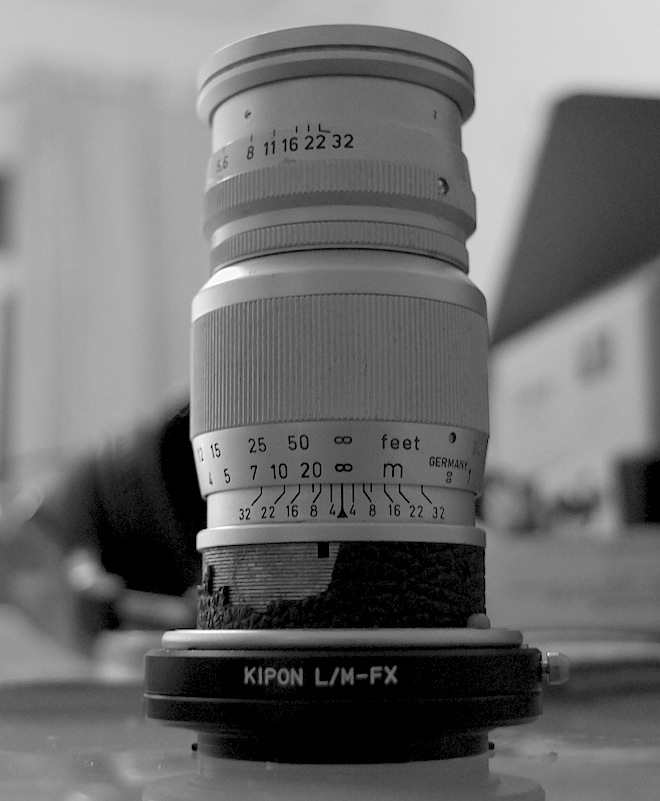
This week I found a very old Leica Elmar from the 50′s. These are all over the place you just have to look for them.
Leica M Elmar 90mm F4
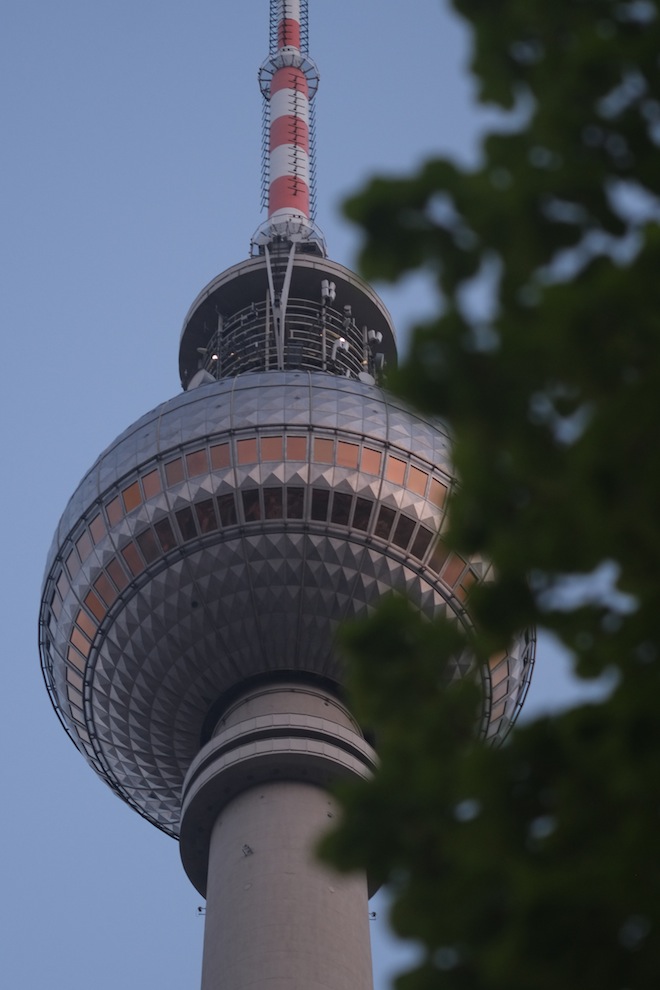
I picked this up for just 95 EUROS which by Leica moneybags standards is a pittance. Sure it is only F4 but that gives me a beautifully sharp image with manageable focus. It is a full frame Leica M mount lens but I use it on the Fuji X Pro 1 and Sony FS100 which are 1.5x crop. A lot of old Leica glass like this are considered collectors items but this one is cosmetically damaged near the mount. I don’t give a crap about this and I wanted it because of the character of images it produces. It is a low contrast lens which seems to increase the dynamic range of the camera, delivering velvety smooth tones like film. Here’s one from the Fuji X Pro 1 taken with the Leica M Elmar 90mm F4.
Leica M 90mm F4
I also enjoy pairing Russian optics with anamorphic lenses. Now the Iscoramas are expensive but a Kowa 2x lens gives you a very similar image (if not a tad sharper!) for locked off shots for around $500, if you don’t mind the slow focussing mechanism of matching the focus point on both the prime and the anamorphic.
Here’s the look you can get when you pair a very very basic $20 Russian Helios 44M-2 lens with an anamorphic (in this case my 2x Isco CentaVision)….
So next time you are about to drop $1500 on a lens – make sure it is either an anamorphic, or something unique. Picking a modern piece of glass, with sterile multi-coating and perfect MTF chart is not always the best look for cinema.


Source: EOShd

01 April, 2012

Canon Makes Pro Photographers Drool With EOS 5D Mark III DSLR Camera

Canon Makes Pro Photographers Drool With EOS 5D Mark III DSLR Camera

March 02, 2012 By Peter Pachal on Mashable

Canon just unveiled a new high-end digital SLR (single-lens reflex) camera for pros.
The new camera called the EOS 5D Mark III has a brand-new image sensor makes it the highest-resolution DSLR that Canon’s ever made.
The full-frame CMOS sensor lets the 5D Mark III capture photos up to 22.3 megapixels — about 4 megapixels more than Canon’s top-of-the-line EOS-1D X (the 1D X has other features, like dual image processors, that let it retain its flagship status). Resolution isn’t everything, of course, and Canon says the new sensor has higher sensitivity and better noise reduction than its previous sensors, which means it should perform superbly in low light.
There’s also better data transfer between the sensor and the image processor. That improves video quality and lets photographers snap six pictures per second at full resolution.
The camera’s ISO range is adjustable from 100 to 25,600 in standard mode, but you go down to 50 if needed for studio or landscape photography. You can also crank it all the way up to 102,400, and Canon’s press release finally clues us in on to who outside of mole people would want to do so: law enforcement, government or forensic field applications. Well, there you have it.
There’s a lot to like in the EOS 5D Mark III for pro videographers, too. The camera can record video in numerous HD formats: 1080p (at 24, 25 or 30 frames per second) and 720p (60 or 50 fps). It also includes more video compression formats that Canon says will help speed up post-production work. The new full-frame image sensor is also said to reduce moiré — the annoying “blending” you sometimes see when you shoot patterns like multiple parallel lines.
To help capture longer-form video, the camera can capture footage continuously for about a half-hour, automatically splitting it across multiple 4GB files. Dual CompactFlash/SD card slots help ensure you don’t run out of space.
The 5D Mark III also gets the 61-point autofocus system currently on the flagship 1D X. Every single point is manually selectable, though the camera divides them into areas, prioritizing the points depending on your aperture. They’re also assisted by a tracking algorithm for when you’ve got a moving target on your hands.
Finally, the 5D Mark III gets in-camera HDR (high dynamic range) shooting. This feature, which is now even on cellphone cameras like the one on the iPhone 4S, merges three images captured at various exposure levels into a single image. The result tends to be more dynamic color and enhanced detail.
One notable absence from the EOS 5D Mark III: continuous auto focus for shooting video. Canon again has chosen to eschew the feature, which has been present in many Nikon DSLRs for a while. While manual focus tends to give better results and doesn’t make any noise, on Canon DSLRs it’s simply not an option.
The Canon 5D Mark III goes on sale at the end of March for $3,499 — that’s for the body only. If you want a kit with a lens (with 24-105mm zoom), that’ll cost you $4,299. A boatload of accessories for the camera, including a GPS receiver and wireless transmitter, will all be on sale by April. More information is at Canon’s site.
What do you think of the Canon 5D Mark III? Complete want, or is it missing anything you’d like to see? Let us know in the comments.
Canon EOS 5D Mark III DSLR
The EOS 5D Mark III is the highest-resolution DSLR camera that Canon's ever made.

Canon EOS 5D Mark III, No Lens

Canon EOS 5D Mark III, Back

Canon EOS 5D Mark III, Top

Canon EOS 5D Mark III, Left Side

Canon EOS 5D Mark III, Right Side

Canon EOS 5D Mark III, Front With Lens

Canon EOS 5D Mark III, Top Angle

Canon EOS 5D Mark III, Side View With Lens

Canon EOS 5D Mark III, Top View With Lens

Canon EOS 5D Mark III, With Battery Grip

Canon EOS 5D Mark III, Front View With Battery Grip

Ayeza Khan Photoshoot 2020, Ayeza Khan Photos, Ayeza Khan 2020 New

Ayeza Khan Hot Photoshoot Ayeza Khan Hot Photoshoot, Ayeza Khan, Ayeza Khan Photos